Instant Avatar redraws the moving parts instead of rebuilding the whole character
One uploaded drawing stays the source of truth. We redraw the two eyes and the mouth and nothing else, because every unrelated difference between two frames becomes motion.
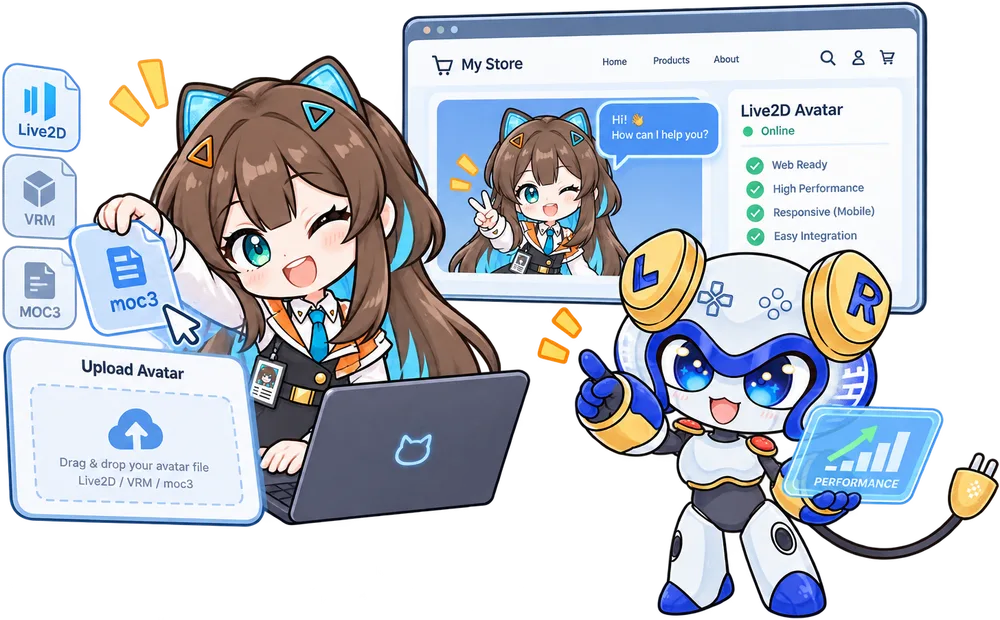
A merchant uploads one drawing of their character. To make it blink and speak, something has to produce more pictures of that character, and the obvious way to get them is to hand the whole illustration to an image model and ask for a version with the eyes closed.
We do not do that, and the reason is worth more than the mechanism is.
What a general redraw costs you
An image-to-image pass will keep the broad idea of a character and quietly change the rest. The hairline moves a little. The line weight thickens. An accessory loses a strap. Any one of those is acceptable in a picture judged on its own.
They stop being acceptable the moment the picture is a frame. A blink is two images alternating against the original artwork, so every unrelated difference between them becomes motion. A blink that also changes the eyebrow is not a blink, it is the character flinching. A speaking mouth that drags the jaw with it is not speech.
So the standard a state has to meet is not "is this a good picture of the character". It is "is this the same picture, apart from the part that moved".
Three marks, and nothing outside them
During framing the merchant places a marker over each eye and one over the mouth. Those three marks are the entire licence we give the generator.
The eyes need states that read as a blink. The mouth needs shapes that read as speech. Everything else — hair, collar, costume, palette, background, the logo on the sleeve — is not a generation problem, because none of it is moving. It stays the bytes they uploaded. The compositing step that enforces that is worth its own post.
That changes what can go wrong. We are not producing a second, nearly identical character and hoping the unrelated details survive the trip. There are no unrelated details in the output. There is the original, with three regions replaced.
Why fidelity beats novelty here
For a store mascot the source image is usually settled work. Somebody chose that expression, that costume, that drawing style, and often somebody was paid for it. It may be the only picture of the character that exists.
A pipeline that regenerates the whole frame puts every one of those decisions back up for negotiation on every call. Restricting the redraw makes the artwork the stable base rather than a reference the model is free to reinterpret.
It also makes repair legible. When an eye does not close convincingly, that is an eye problem, and we rerun the eye. The merchant does not have to accept a new version of their character's hair to fix one animation state.
A still image is the wrong thing to judge
We do not treat a state as finished because the redraw completed. The studio previews the character blinking and lip-syncing, and the checks are about behaviour rather than picture quality: does it still look like the source character, do the eyes visibly close, does the mouth visibly open.
That is a different bar from evaluating a still. A closed-eye texture can be perfectly clean and still fail as a blink, because the change is too small to read at the speed a blink happens. A mouth state can be well drawn and still fail to communicate speech. The preview exists to catch the failures that only exist in motion, and a failed state is rerun on its own.
A professionally rigged model carries parameters, deformers, physics, expressions and authored motion. A single illustration carries none of that structure. Instant Avatar is for the merchant who has a character and not a rig, so it concentrates on the smallest set of movements that can be derived from one picture while keeping that character recognisable.
The narrow constraint is the product
Image models are usually sold on how much of a picture they can change. Here the opposite property is the valuable one. The system should have as little reason as possible to touch anything that is not moving.
That gives the pipeline a contract we can state in a line: the uploaded illustration stays the source of truth, the marked regions supply the animation, the preview decides whether the animation reads, and a rerun repairs one region when it does not.
For a storefront character that keeps the generated work subordinate to the merchant's design. We add motion where motion is missing. We do not treat somebody's mascot as material.